Cardiac Rehab: Building Confidence during Recovery

When your heart gives you a scare, the road to recovery can feel overwhelming. Where do you start? How do you know what’s safe? And perhaps most importantly, how do you keep fear from holding you back?
For many patients at Memorial Health hospitals, cardiac rehabilitation has become more than just a program. It’s a lifeline, a community and a pathway back to a normal life.
A Comprehensive Approach to Heart Health
According to Kim Kersey, RN, and Michele Kilduff, RN, who work with cardiac rehab patients at Taylorville Memorial Hospital (TMH), the benefits extend far beyond physical conditioning. “So many of these patients are scared when they come in,” Kersey said.
“When a 45-year-old or a 75-year-old has open heart surgery, it’s very scary,” Kilduff added. “They realize they could have died and are fearful to resume normal activities.”
That’s where cardiac rehab makes all the difference. The program offers three distinct phases:
Phase 1 begins immediately after a cardiac procedure, right in the hospital, with staff helping patients take those first important steps.
Phase 2 is an outpatient program where patients come in three days a week to exercise while being continuously monitored on heart monitors. Nurses track heart rate, rhythm and blood pressure before, during and after each session.
Phase 3 offers continued support for graduates of Phase 2 who want to maintain their progress in a supervised gym environment with nursing staff always available.
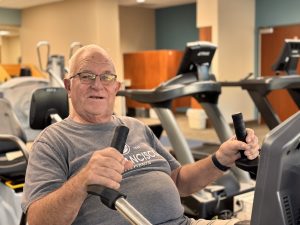 Feeling Secure
For Gary McCullough, a 78-year-old retired Taylorville schoolteacher, that constant presence of skilled nurses provides invaluable peace of mind. After having his aortic valve replaced twice—once in 2017 and again in 2023—he learned an important lesson.
“After the first time, when I quit going, I would quit exercising on a regular basis,” Gary said. “This most recent time, I decided I wasn’t going to quit.” He’s now attended cardiac rehab 290 times and counting.
A Second Chance at Life
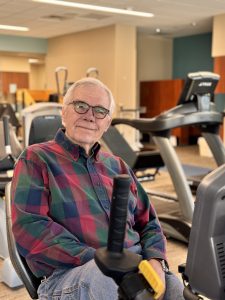 Richard Breckenridge appreciates going to cardiac rehab in his own town. The retired rural policy advocate experienced a heart valve replacement in January 2024 that took an unexpected turn. “All of a sudden, my heart quit,” he said. After three days in ICU and emergency placement of four additional stents at Springfield Memorial Hospital, he came home grateful to be alive.
Two weeks later, he started cardiac rehab at TMH. “Going into a program where I had two nurses and one was an Emergency Room nurse sitting down with me—I was monitored every second I was there,” Richard says. “That gave me great comfort because going through that heart issue was really not fun.”
Almost 80 years old and in Phase 3, Richard has lost 40 pounds and exercises three days a week without fail. “I started at five minutes and struggled for five minutes. Now I’m at 14 minutes, and I hit it pretty hard. I just feel better. People say you don’t look 80. I’m glad I don’t!”
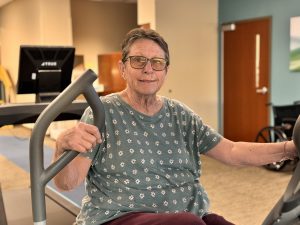 Finding Strength in Community
For Barb Easterday of Nokomis, the 25-minute drive to TMH three mornings a week is more than worth it. After a 95% blockage in her left anterior descending artery was discovered and treated with a stent, she started cardiac rehab in late June.
“I couldn’t have asked for anyone better to work with than Kim and Michele,” Barb said. “They are the greatest! Helpful, explanatory, concerned all the time, making sure everything is going alright.”
Now in Phase 3, Barb continues because of how much better she feels. “I know someone is there if I have an issue or if I have questions,” she says. “I can’t say enough how much it means to me to have that available.”
Gary puts it simply: “It’s a community. We have so much fun.”
Why Cardiac Rehab Works
The program’s success comes from combining several critical elements:
- Immediate monitoring and intervention. Nurses can spot problems instantly and get patients the care they need, whether that’s a medication adjustment or a trip to the ED.
- Education and risk reduction. Through videos, handouts and discussions, patients learn how to prevent future heart problems and manage their risk factors.
- Emotional support. Hearing other patients’ stories helps people realize they’re not alone. “Patients are more likely to ask questions when they hear others asking questions,” Kim said.
- Expert guidance. Trained nursing staff bring both clinical expertise and genuine care to every session, creating an atmosphere where patients feel supported and confident.
No matter your age or whether you’ve had a valve replacement, bypass surgery or a stent placement, cardiac rehab offers the support, expertise and community you need to recover with confidence.
If you or a loved one has experienced a cardiac event and would like to learn more about the hospital cardiac rehabilitation programs offered through Memorial Health, talk to your cardiologist for the program nearest to you.