When a Routine Antibiotic Leads to an ICU Scare
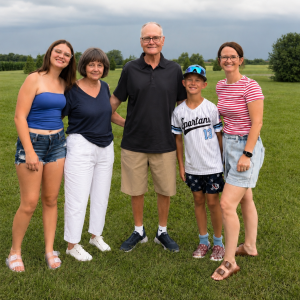 Roger Hawkins didn’t expect a routine antibiotic to turn into the scariest week of his life.
It started small. The day after his first dose, a rash appeared, like a bad sunburn. He and his wife Cindy went back to the doctor who prescribed a salve for his hands, but it didn’t help.
His hands swelled. The rash spread. They went to the emergency department near their home in Urbana, where doctors determined what was happening: Stevens-Johnson syndrome, a rare and severe reaction that causes the skin and mucous membranes to blister and break down.
As the swelling reached his throat, doctors made the call to intubate him.
Then came the search for a burn unit bed. The team in Urbana called hospitals across the Midwest: St. Louis, Indianapolis, Rockford, Chicago. Every facility full.
Springfield Memorial Hospital (SMH) was also full, but when an ICU bed opened, their answer changed to yes.
Five Nights, Six Days of Exceptional Care
Roger was airlifted to Springfield. Cindy followed. What came next was an experience neither of them will forget, partly because of how frightening it was, but mostly because of how they were treated by the SMH team – with conscientious care and remarkable kindness.
Roger, for his part, doesn’t remember much of those first couple of days. What he does remember is how every single person he encountered: the nurses, technicians, doctors, even the man who walked him to his car the day he left … they all treated him with patience and kindness, even when he needed help with things he never imagined he’d need help with.
Cindy has an HR background in healthcare, and she found herself watching the staff at SMH with a professional eye as well as a wife’s perspective.
“They must have an excellent team that knows who to hire as well as an excellent training team,” she remembers telling her daughter, who is also an RN. “I have never seen an organization where there was not one individual who didn’t excel.”
Her list of examples goes on and on, and still she and Roger feel badly they can’t remember everyone’s names and all the ways those caregivers created such a positive care experience.
There was Dan who walked her personally to the cafeteria when she needed to find something to eat; Eddie, a tech who reassured Roger during personally awkward care moments; the nurses who called her when she was making the drive from Urbana to Springfield to update her on Roger’s early morning physician rounding; the ICU nurse who called to prepare her ahead of time that Roger’s latest round of scans looked good, but that he was anxious.
Oh, and the colleague who brought up two servings of ice cream for Roger because “that’s what I would want.”
 The Customer Service Impact
Roger spent years running businesses, including auto dealerships, before a second career helping auto dealers learn new software. He calls himself an intense critic.
He simply cannot understand, from a business standpoint, how an organization the size of SMH could have him interact with as many as fifty different people and have every single one of them get it right.
“Maybe a company could meet 98% in a best-case scenario,” he said. “How does a place reach 100%? That is absolutely what happened.”
Soon, Roger was well enough to go home to Urbana, where he continues to see specialists as he recovers. He and Cindy still talk about what they learned – to always ask about drug interactions before starting a new medication – but mostly, they talk about the people who cared for them when it mattered most.
“That kindness and customer service, the attention to patient care matters,” Cindy said. “That one little extra encouraging word goes a long way.”